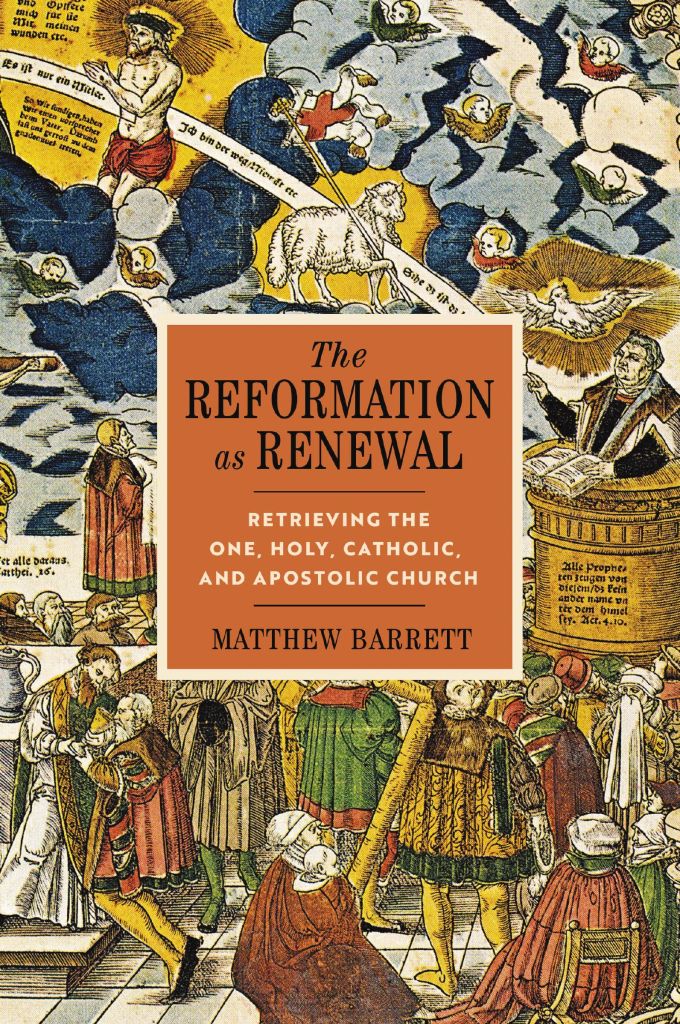
A Review of Matthew Barrett’s The Reformation as Renewal, Retrieving the One, Holy, Catholic, and Apostolic Church.
I am a father of three young children. One of their greatest joys as they begin to learn to speak is the perpetual use of the word “no.” Whether it comes to trying a new food, getting dressed, or leaving a place they were enjoying, there is a certain thrill to denying someone else, even if there isn’t a specific reason why. A ton of theological implications arise from this, something I’m sure Lindsey would love to expand upon at some point.
We do not grow out of this tendency, it seems. Adults seem to enjoy as much as children the opportunity to tell someone, especially those in a position of authority, a clear and resounding “No.” At the right time (and with the right backing of logic or truth), denying a person or people who are wrong is a powerful experience. The most casual reader of the gospels can see this, as Jesus spoke truthfully to the Jewish and Roman elite, fearlessly telling people they were wrong and in need of a complete turnaround.
For a long time, the discussion around the Protestant Reformation seemed to revolve around a similar impulse. The common narrative states that the Roman Catholic church had grown bloated and gilded, separated from any semblance of good faith and order. Martin Luther, the heroic monk of Wittenberg, began the Reformation with his dramatic posting of 95 theses on the church’s door. The kindling had been accruing for many years, and it only took the courageous act of one convinced of Scripture’s truthfulness to actually ignite the discontent into fully-fledged reform against church and state alike.
Matthew Barrett, Professor of Christian Theology at Midwestern Baptist Theological Seminary, has offered a significant voice into the conversation surrounding the Reformers. Specifically, in his newest release The Reformation as Renewal: Retrieving the One, Holy, Catholic, and Apostolic Church (Zondervan Academic, 2023), he seeks to change the way in which many modern Protestants view their spiritual ancestors:
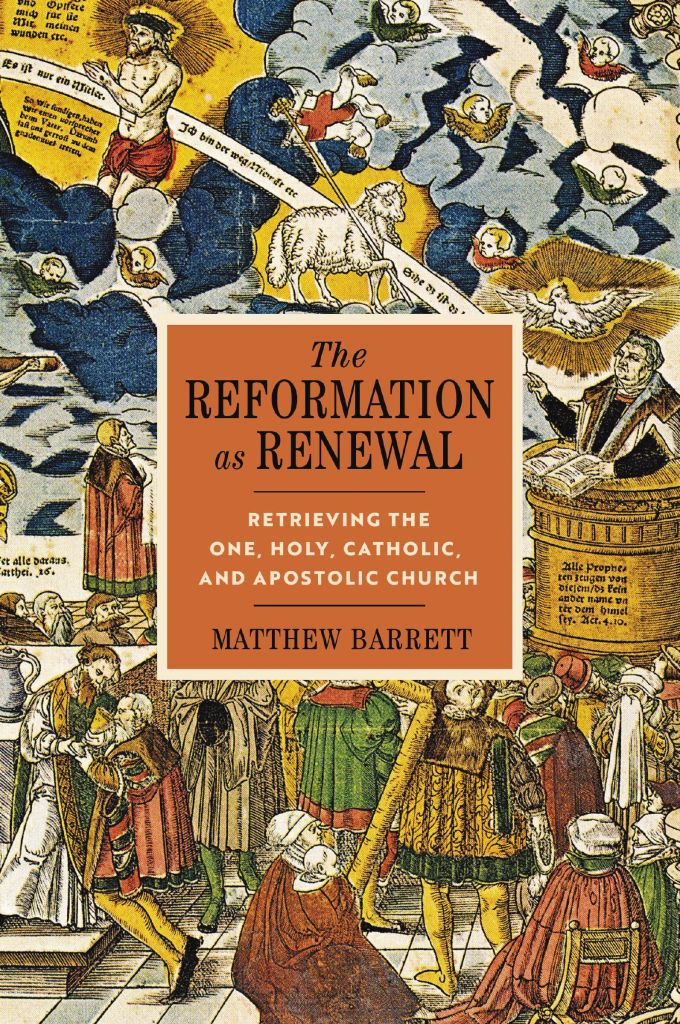
“If the Reformers’ own perception is considered, then the story of the Reformation is not a story of a rebellious departure from the church catholic but a story of renewal” -p. 32 (Emphasis Barrett’s).
One of the major efforts of the book is to break down the “oppositional narrative,” the idea that the Reformers were a theological demolition crew. According to this narrative, Luther and Calvin were concerned only with tearing down what existed and creating a new church and state order based upon faithfulness to the Scriptures alone. Rather, Dr. Barrett’s massive work argues persistently that Protestants did not want to leave the church, by and large, but wished to stay as faithful members and steer her back to biblical fidelity. This is quite helpful in the discussion surrounding the Reformation, as the current dialogue seems to position the Reformers more in line with a bulldog commentator on a political show rather than concerned members of a church, trying to save it from itself.
Defining the Reformation
What exactly was the Reformation about? Was it the church’s ultimate source of authority? Was it indulgences? What about justification by faith? Was it a political movement covered up in religious jargon? Words mean things, and proper definitions are crucial in any conversation, much less one as historic as the Protestant Reformation. That is why Barrett’s explanation of the different ways “tradition” is used by historians is so crucial. Paraphrasing Heiko Oberman, Barrett establishes two different paths used by theologians to describe tradition in the Reformation:
Tradition 1 (T1) – the sole authority of Holy Scripture is upheld as the standard of revealed truth in such a way that Scripture is not contrasted with Tradition. The history of obedient interpretation is the Tradition of the Church.
Tradition 2 (T2) – an oral tradition originated from the teachings of Jesus during the forty days between his resurrection and ascension, which serves as a complement of Scripture. This tradition was handed down to the church as a second source of revelation. (pp. 325-326)
This is important enough to wade through the jargon- the Reformers were not against tradition in and of itself. In fact, the traditional interpretation of Scripture was considered the faithful one, unless it could be disproved directly from the Scriptures themselves. So, for understanding something as God being Triune, the traditional formulation of Nicea would be held as authoritative in the church, because it was an obedient interpretation by the church. There is no scriptural evidence which overturns the doctrine of the Trinity, so it is right to hold this as a core doctrine of the faith, even though the word Trinity does not itself appear anywhere within the Bible.
Barrett affirms this later on, when he clarifies the term Sola Scriptura:
“Sola Scriptura, according to Luther, presupposed Scripture’s divine origin and infallible, inerrant nature…That does not mean, however, that Luther disowned the Fathers or believed they and their councils were without authority. Sola Scripture was not, as perceived in popular narratives, a battle between Scripture and tradition, as if the Reformers were against tradition. They were not.” (p. 415)
In fact, the Reformers viewed tradition has having authority, just not as much as Scripture. For the Reformers, the Bible had magisterial (supreme) authority, while tradition had a ministerial (subordinate to the magistrate) authority. Just because it was not as supreme as Scripture never meant that traditional interpretations of God’s Word were unimportant. To argue otherwise is to simply describe something which did not exist.
Additionally, the Reformation did not cleanly begin on October 31st, 1517. Barrett gives ample space to debunking the idea that Luther was the sole initiator of the Reformation. Since Luther, Calvin, and Zwingli viewed themselves as being in continuity with the church fathers, they strived hard to show that they were more in line with the church fathers Rome claimed as her own. Aquinas, and Augustine would have been equally opposed to the church of Rome in the Reformation’s days, at least according to those seeking reform. And they were not alone. John Wyclif and Jan Hus receive ample attention in the book before the narrative finally shifts to the more well-known Reformers in Germany and France. This is a breath of fresh historical air, as those wrapped up in the oppositional narrative can easily overlook the contributions the English Wyclif made in Bible translation and the Czech Hus in dealing with church corruption from within. These men, along with other peers in the 14th and 15th centuries, laid much of the groundwork in preparation for the events of 1517.
How Should We View the Reformation Today?
As modern readers consider the Protestant Reformation, it is important to remember that we have the luxury of reading histories much as we would the Gospels. We know how they end. The Reformers themselves had no such luxury. Just as the disciples had no idea about the coming events of Christ’s passion and resurrection, those who called for renewal within the only church they knew operated on a similar level of faith. They only knew the realities of their immediate context and tried to apply biblical faithfulness to it. Famously, Luther anticipated the very real possibility of death at several points during his confrontation with the church. Modern students of the Reformation have to remember their place when looking so far back in history.
As I read this book and wondered how we can apply the work Barrett has done here, two things come to mind. The first is how we might tackle theological triage with the Reformers in mind. The prevalence of the oppositional narrative can easily lead to a polarized view of Protestants and Roman Catholics, both in history and today. Everything the Reformers did was right and biblical, while everything coming from the papacy was heretical. It is important to remember the great deal of agreement Luther had with his church, and just how difficult it was for him to break away. Modern church leaders have much to learn from this, as they can tend to see themselves as wholly opposed to other denominations and church bodies rather than in much historic agreement. When we see Luther (and by extension, those who agree with him) as a sort of hammer to be wielded against theological error, everything can quickly turn into a nail. We must remember instead the need to speak lovingly in all truth. The loss of a brother, even over a legitimate disagreement regarding biblical interpretation, is a loss nonetheless.
The second, and more important, application of the book comes at the very end. Barrett recounts where a woman at his church excitedly told him she now saw that “we Protestants are not a sect. We too have a rich, ancient heritage in the one, holy, catholic, and apostolic church. We have a history we can be proud of just as much as anyone else!” (p. 888). Every person who traces their lineage back to the Protestant Reformation must understand this- the church as they know it did not begin in 1517. Luther is not our evangelical pope. To more completely understand Luther is to see what he saw- that he was in line with countless brothers and sisters in the faith before him, and that he only wanted to take the church back into her proper place.
Conclusion
The Protestant Reformation is one of the most important events in church history, and one of the ones with which modern Christians have the greatest familiarity. Unfortunately, the oppositional narrative surrounding the Reformers has taken a strong hold in most Christian circles. The attraction of the oppositional narrative is that it tells a historical story with more drama. Rather than memorizing names, dates, and events, the mood of the Reformation is one with which readers can easily empathize. There are clear heroes and villains. It was a life and death situation for many, even if made much easier to think about when death is removed by several centuries. Simply put, the Reformation is a dramatic story, but one in which the drama quickly outpaces the details.
The value of The Reformation as Renewal is that it adds nuance to an oversimplified narrative. Although a four-letter word in our polarized culture, nuance is crucial to understanding something as massive as the theological and political shifts of an entire continent over several hundred years. Nuance requires work, either the massive work of writing or much lesser work of reading 800 pages of argument and evidence from history.
When my children were at the age where “No” became the dominant word in their language, I had to understand that maturity and age would eventually win out. They would learn to use other words to speak about what they did or did not want. Thankfully, they did. They learned to reason, to ask for something in different ways, or to give reasons for why they wanted something. We could learn much from this as we turn to our spiritual forefathers. They were driven not merely by a basic impulse to say “No!” as a defiant toddler might. Rather, they were convinced doctors of the church who wished to nurse her back to health, while never wavering in Scriptural fidelity. Matthew Barrett’s book would be a great resource for those who want to know more about the driving motivation of the Reformers- renewal, not rebellion.
You can buy The Reformation as Renewal from Zondervan Academic, Amazon, and many other retailers online.


Leave a Reply