Texas is full of powerful symbolism. An oil derrick which stretches into twilight skies showcases energy history and potential. The Alamo building, to which defiant resistors of government overreach look for inspiration. Or the longhorn, which although not a native species, has been adopted as one of the most used images of Texas landscape. These emblems convey some of the story and romance of the state, and provide its people with a story of origin and direction.
For those who know it, perhaps the most recognizable and revered symbol Texas owns is the badge of the Texas Rangers, the five-point star surrounded by a circle worn by the elite law enforcement. In the Lone Star State, a little can convey a great deal, and it is with pride that these officers wear this simple badge with a large story.
Doug Swanson, Associate Professor of English at the University of Pittsburgh, tells that large story in Cult of History: The Bold and Brutal History of the Texas Rangers, published by Penguin House in 2021. Starting with the earliest known Rangers of Stephen F. Austin’s early colonization efforts to the modern force Texans know today, Swanson strives to show that the Texas Rangers have a unique place in the story of one of America’s most unique states.
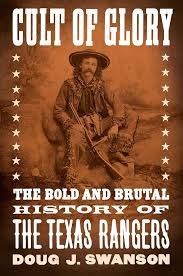
However, as the title implies, there is a clear point to the book. Swanson pursues dual themes throughout the book which primarily focuses on the organization throughout the 1800s and early 1900s. He focuses on 1) the quick and willful violence Rangers used against perceived foes (often of a different ethnicity) and 2) their knack for promotion of a larger than life reputation.
Violence in the Name of Justice
Swanson’s title makes it clear that the Texas Rangers own a violent history. While they were established “to act as rangers for the common defense,” the earliest force served more as an offensive weapon against whatever group early white settlers and later citizens felt posed the greatest threat. In the (Texan) colonial days, it was the Karankawa and Comanches who struck the greatest fear. Once on horseback, Indians became mighty warriors who were quick to outrage and murder white settlers simply trying to make a better life for themselves. Therefore, the measure of a Ranger was his ability to fight and kill as many Indians as possible. Even in defeat, early Rangers registered success by how many scalps they retrieved from the enemy dead, even if that numbered less than their own casualties.
Once relations with Mexico soured into a revolutionary fervor, Rangers were ferocious in their interactions with Mexicans on either side of the Rio Grande. A skirmish at Salado Creek near the Alamo turned into a slaughter of Mexican General Adrian Woll’s infantry forces, only for the favor to be returned when a small company led by Nicholas Dawson overpursued the enemy and fell into a deadly ambush, where at least 35 Texans died in their own one-sided defeat. For nearly a century, the border between Texas and Mexico was stained by blood from combatants and citizens from both sides.
The border conflict continued for several decades after Texas independence, most notoriously climaxing in the Mexican border war of the 1910s. Rangers led raids against those they suspected to be bandits, even if they were peaceful citizens on either size of the border. A company of Rangers deployed to the border created a ‘black list’ of over 200 Tejanos and Mexicans, killing them as quickly as they added them to the list. The violence reached the point that the state government could not ignore it, and Governor James Ferguson officially ordered the force to “cease the summary execution of Mexicans.”
Perhaps the most shocking escalation of violence came outside the village of Porvenir, in which a small team of Rangers led away 18 Mexican men and young boys and executed them within earshot of their families. After fleeing away from the violence back into Mexico, one of the new widows gave birth to a girl. This daughter would never know her father, Manuel Morales, due to his murder and coverup at the hands of the Rangers.
Promoting the Ranger Image
Law enforcement officials benefit from a strong public image. Toughness, integrity, and service are values many find particularly important. Those who carry out the law on the behalf of others must possess a level of public credibility. Maricopa County’s famous sheriff Joe Arpaio was famous for his media awareness and self-promotion, and his real-life example strongly informs Jon Hamm’s captivating performance as the “constitutional sheriff” Roy Tillman in Season 5 of Fargo.
In Swanson’s view, the Texas Rangers possess a similar knack of promotion and self-preservation. The first image of any Ranger in the book comes just before the prologue, where Manuel T. “Lone Wolf” Gonzaullas poses dashingly for the camera, with an attached quote that “the most dangerous place in Texas is between Gonzaullas and a camera.”
To be fair, this was not exclusively the work of the Rangers themselves, but also a media ecosystem which feasted on the fabulous and overlooked the ordinary. Although General James Polk received the highest honors for his successful command in the Battle of Palo Alto, multiple newspapers singled out Captain Walker for his steadfastness as the battle’s ebb. Within a few months, he was on a celebratory tour which culminated in Washington D.C., where he delivered a report to Congress on the war’s progress. At various cities, Walker was the toast of the party, and when he returned to the Mexican front (where he was killed shortly thereafter), provisions and reinforcements accompanied him.
It is understandable, to some extent, why the Rangers were so willing to tell their story- an eager audience wanted to hear about them. The public’s credulity and awe filled a basic human need to be seen and valued- very few of us would stop a reporter from writing a fawning piece on how great we are. Whether telling the story themselves or allowing others to do so with little resistance, Rangers throughout the 19th and 20th centuries mastered the battle of the press as effectively as any law enforcement agency in the nation. They seemed heroic without being foolish and powerful without being domineering.
Of course, this can lead to excesses in the desire for a quick name in the press, illustrated most clearly in the tragic handling of Henry Lee Lucas. After being arrested for unlawful firearm possession in 1983, Lucas realized that he could attain serial killer superstardom through confessing to as many murders as possible. Although there were inconsistencies from the outset, the sad reality is that the Rangers, led by Bob Prince, engaged in shoddy police work to add as many confessions as possible. Lucas was allowed to see photographs and reports of the crime scene before being interrogated, which means he could offer enough specific detail to assuage all those involved that the confession was genuine and yet another case was closed. Prince and the Rangers took the “Lucas Show” to at least five states and a dozen jurisdictions in Texas, receiving confessions for several hundred murders (at least 50 in 1982 alone!). Of course, when the inconsistencies in his stories unraveled the entire narrative, families of alleged Lucas victims had to go through yet another heartbreak of learning that their loved ones’ killer remained unidentified. More than being professional, the Rangers wanted to be publicized.
The Problematic Historiography of Problematic Institutions
“The Army doesn’t care.”
“The Army won the war.”
“The Army has made a decision.”
This type of language was nearly ubiquitous during my time in the service. Anyone who has spent time in the Army, any other branch of the military, has probably heard phrases similar to the one above. After talking to an individual soldier or an Army civilian, someone equates that interaction, whether positive or negative, and expands that to an opinion of the entire service. This is not anything unique to the military, but something that happens in institutions of all sizes. Universities. Local city departments. Political parties. The federal government. The organizations which make up so much of our daily lives become some sort of monolithic, impersonal object which has its own will, personality, and preferences.
It should hopefully become clear that the problem with such logic is a shortsightedness to the nature of individuals and corporate organizations. Institutions and organizations are made up of individual people, and while we can look to smaller personal examples of behavior or belief to build a description, we must realize that there is a limit to what we can definitively say about the rest of the group. To do so runs the risk of overreach, something responsible researchers should be careful of.
In Cult of Glory, Swanson takes this principle and runs with it. What he offers is not necessarily a history of the Texas Rangers as an organization, but more of an anthology of individual Rangers from which he then extrapolates greater concepts of the whole. If the goal is to write a history of the Texas Rangers, it makes sense that the history would include some of the agency’s formation and evolution. While the ground level history provides key evidence for his thesis, it would have been made much stronger to see similar attitudes and behaviors at the upper levels of the division. Who were the leaders who dictated the direction of the agency, and did their prerogatives cause any clashes with the Rangers on the ground?
Additionally, Swanson’s seemingly single interaction with a ranger on the ground level, Brandon Bess, provides a different lens. He calls Bess professional, congenial, and even with a touch of modern romantic ties to the past. When the majority of your argument is built on individual examples of malfeasance and vigilantism, it loses some of its teeth when your only documented interaction is the exact opposite.
Fair historical analysis must rely on the samples it has, and much can be said about the opposite danger of ignoring negative examples in order to present a more positive story. One has to think only of how selective media coverage can shape the public’s perception of the police. There is a tension between balanced writing and writing to prove a hypothesis. Unfortunately, I believe Swanson commits the latter.
For a reader to trust that they are reading a comprehensive history, they must believe that they are engaging with facts of an organization, from the top to the bottom. Unfortunately, Cult of History overemphasizes the ground level and leaves the upper echelons of the Texas Rangers unaddressed. With such an unbalanced approach, readers cannot walk away knowing that they have heard the full story.


Leave a Reply