Introduction
It was a study of opposites this week. The children were off for their fall break, the first of TWO weeks out of school. On my end, I had to make a brief presentation on the effect of print on religious scholarship. Although the discussion seemed to go well, I couldn’t help feeling that I missed the mark somewhat, focusing more on secondary discussions about the sixteenth century book trade.
Research
This week I was tasked to give a short presentation to an MLitt course I am auditing. The topic is “The Impact of Print on Religious Scholarship,” a rather broad term. To that end, several of the notes that I used to build this presentation.
- Once you start studying religious printing in the first century after the advent of the printing press, it is easy to find good quotes.
- GERMANY – Luther himself saw print as a divine gift: “All arts and disciplines have now reached their highest peak, even though at the same time they are held in the utmost contempt—and this is no wonder, seeing that Christ himself, the supreme gift, is so deeply despised in the world. Printing is the latest gift, and the greatest one too; for through it, God willed that the cause of true religion be made known to the whole world at the end of time and be spread into every language. It is truly the final, inextinguishable flame of the world”
- ENGLAND – John Foxe was equally enthusiastic “As we haue great cauſe to geeue thanks to the high prouidence of almighty God, for the excellent arte of Printing, moſt happely of late found out, and now commonly practiſed euery where, to the ſingular benefite of Chriſtes Church, wherby great increaſe of learnyng and knowledge, with innumerable commodities els haue enſued, and dayly doe enſue to the lyfe of man, and eſpecially to the fartherance of true Religion”
- My favorite comes from Filippo de Strata, who, as a Benedictine scribe, had an unsurprisingly low opinion of the effect of print on the scholarly environment.
- “This is what the printing presses do: they corrupt susceptible hearts. The silly asses do not see this, and brutes rejoice in the fraudulent title of teachers, exalting themselves with a song like this (be so good as to listen): ‘O good citizen, rejoice: your city is well stuffed with books. For a small sum, men turn themselves into doctores in three years. Let thanks be rendered to the printers.’ Any uncultured person without Latin bawls these things.”
- When beginning to study any new topic, a good student should come to learn who the dominant voices are in their field, where there are significant agreements, and where there might be points of friction.
- That said, Reformers seemed to see in a widespread adoption of printing an arena in which they could compete and win.
- The evils of indulgence sales were quickly illustrated by Reformist printers through pamphlets and woodcuts.
- On aplas von Rom kan man wol selig werden durch anzaigung der Goetlichen Hailigen geschryfft. (Augsburg, Melchior Ramminger, 1521).
- The Reformation and the Book, Gilmont, Jean-Francis (Aldershot, Ashgate Publishing, 1990).
- “The Reformers, by contrast, quickly seized upon printing to further their ends, recognizing how it made rapid dissemination possible. As Bernhart Hertzog later put it, ‘viel zeit mag ersparet werden / vnd in einem tag mehr durch zwo Personen gesetzt vndd gertrucket werde / dann zuvor zwentzig oder mehr inn etlich Jeren erschrieben könded (‘much time can be saved, and in a single day two men can set and print off more than 20 or more were previously able to write in several years.
- Chronicon Alsatia, Edelasser Cronick, Bernhart Hertzog (Strasbourg: B. Jobin, 1592)
- Print now enabled a story-telling that a former oral and visual society did not previously know.
- “To the familiar romantic theme of the Gothic cathedral as an ‘encyclopedia in stone,’ Frances Yates has added a fascinating sequel. Not only did printing eliminate many functions previously performed by stone figures over portals and stained glass in windows, but it also affected less tangible images by eliminating the need for placing figures and objects in imaginary niches located in memory theatres. The way was paved for a more thorough-going iconoclasm than any Christian church had ever known. ‘The “Ramist man” must smash the images both within and without, must substitute for the old idolatrous art, the new images-less way of remembering through abstract dialectical order.’”
- The Printing Press as an Agent of Change, Elizabeth Eisenstein (Cambridge University Press, 1982)
- “To the familiar romantic theme of the Gothic cathedral as an ‘encyclopedia in stone,’ Frances Yates has added a fascinating sequel. Not only did printing eliminate many functions previously performed by stone figures over portals and stained glass in windows, but it also affected less tangible images by eliminating the need for placing figures and objects in imaginary niches located in memory theatres. The way was paved for a more thorough-going iconoclasm than any Christian church had ever known. ‘The “Ramist man” must smash the images both within and without, must substitute for the old idolatrous art, the new images-less way of remembering through abstract dialectical order.’”
- While print seemed to initially secure the position of the wealthy and educated, the citizens of the imaginary Republic of Letters did not realize that the press would be the great siege works upon their cultural hegemony.
- “Citizens of the Republic carried no passports, but they could recognize one another by certain marks (not wealth, of course—then, as now, scholar did not rhyme with dollar). They looked for learning, for humanity, and for generosity, and they rewarded those who possessed these qualities. Any young man, and more than a few young women, could pay the price of admission. If they mastered Latin, and, ideally, Greek, Hebrew, and Arabic; became proficient at what now seem the unconnected skills of mathematics and astronomy, history and geography, and physics and music; visited any recognized scholar—from John Locke in London to Giambattista Vico in Naples—bearing a letter from a senior scholar, and greeted their host in acceptable Latin or French, they were assured of everything a learned man or woman could want: a warm and civilized welcome, a cup of chocolate (or, later, coffee), and an hour or two of ceremonious conversation on the latest editions of the classics and the most recent sightings of the rings of Saturn.”
- Words Made by Worlds: Scholarship and Community in the Modern West, Anthony Grafton (Harvard University Press, 2009)
- “Citizens of the Republic carried no passports, but they could recognize one another by certain marks (not wealth, of course—then, as now, scholar did not rhyme with dollar). They looked for learning, for humanity, and for generosity, and they rewarded those who possessed these qualities. Any young man, and more than a few young women, could pay the price of admission. If they mastered Latin, and, ideally, Greek, Hebrew, and Arabic; became proficient at what now seem the unconnected skills of mathematics and astronomy, history and geography, and physics and music; visited any recognized scholar—from John Locke in London to Giambattista Vico in Naples—bearing a letter from a senior scholar, and greeted their host in acceptable Latin or French, they were assured of everything a learned man or woman could want: a warm and civilized welcome, a cup of chocolate (or, later, coffee), and an hour or two of ceremonious conversation on the latest editions of the classics and the most recent sightings of the rings of Saturn.”
- This is where Eisenstein’s argument is most at home. The scholarly environment caused by the new mass media of printing was an entirely new world. Gutenberg’s invention was a gate from one era into another, and through which every aspect of culture must pass.
- “A persuasive case, then, can also be made out for regarding the age of incunabula as a major historical great divide and for viewing the advent of printing as inaugurating a new cultural era in the history of Western man” (p. 33)”
- Pettegree, on the other hand, argues for more nuance in understanding the effect of print.
- The Catholic church was not necessarily anti print
- In Brand Luther, Pettegree estimates that over 2.5 MILLION indulgence certificates were printed in the fifteenth century.
- People liked books well before the advent of the press, but the changes wrought by the press simply adapted expectations and appetites for book buying and collecting.
- In The Bookshop of the World, he argues that pre-existing cultural affinities led the Dutch to being the greatest book-collecting people in the sixteenth century world.
- Pre-existing or emerging economic considerations played a larger role in the spread of print than supposed.
- “It was swiftly becoming clear that it was the centres of trade, rather than of learning, that would provide the best locations for production of printed books in the fifteenth century.”
- It was not university towns, like Heidelberg or Oxbridge in Germany and England respectively, but commercial cities like London that became the centers of publishing.
- In his essay on the early print environment in Augsburg, it is the city’s prime position for economic growth which made the print market possible.
- “It was swiftly becoming clear that it was the centres of trade, rather than of learning, that would provide the best locations for production of printed books in the fifteenth century.”
- The Catholic church was not necessarily anti print
- “Print, it was repeatedly proposed, had rescued the learning of the ancients from obscurity. The new technology ‘had turned darkness into light.’ As this book has demonstrated, this represented only one part of a far more complex reality…In fact, the new book world involved a complex process of adaptation, restructuring, and much heartache.” (Pettegree, The Book in the Renaissance, 2011).
- As a brief case study, we will look at two authors, one from sixteenth century France and the other from seventeenth century England.
- John Calvin, the second generation Reformer who spent the majority of his life in Geneva, was a prolific preacher, Scriptural commentator, and magistrate. But he is best known for one book, Institutes of the Christian Religion.
- In the church community, perhaps no book better illustrates the quote made famous by Michael Scott when asked about a leadership book; “Read it, I OWN it! But no, I have not read it.”
- The fact that such work was able to expand with relative stability supports Eisenstein
- Printers and authors were aware of a marked difference between preparing sermons for an oral and printed delivery. The medium of the message affects the construction of the message itself.
- “You cannot but know [that] there is great difference between preparing sermons for the pulpit and for the press. The wisest master builder sees it [is] sometimes expedient to beat often upon one and the same truth, that he may nail it not only to the ears but the hearts of his auditors.”
- Introduction to “A pastors love expressed to a loving people in a farwel sermon preached at Stephens Walbrook”, R.M. (London. August 17, 1662).
- “You cannot but know [that] there is great difference between preparing sermons for the pulpit and for the press. The wisest master builder sees it [is] sometimes expedient to beat often upon one and the same truth, that he may nail it not only to the ears but the hearts of his auditors.”
- Pastors were also aware that the words which were read were to be interacted with as if they had been preached.
- “What was once said to Aegidius of Norenberg concerning David’s words in Psalm 118, they are verba vivenda non legenda. The same may be said concerning these few notions. They are words to be lived, not just read.”
- To the Right Honorable Sir Richard Chiverton, Lord Mayor, the Right Worshipful, the sheriffs, with the rest of the aldermen of the famous city of London, Thomas Watson (London, July 7, 1658).
- “What was once said to Aegidius of Norenberg concerning David’s words in Psalm 118, they are verba vivenda non legenda. The same may be said concerning these few notions. They are words to be lived, not just read.”
- Sermons had a habit of growing when transitioning from pulpit to press.
- “At the request of some friends, I have been induced to publish this sermon. It has swelled something bigger in the press.”
- Introduction to Time’s Shortness: A sermon preached on July 2 at the funeral of Mr. John Wells Late Pastor of Olave-Jury, London, Thomas Watson (London, 1676).
- “At the request of some friends, I have been induced to publish this sermon. It has swelled something bigger in the press.”
Reading
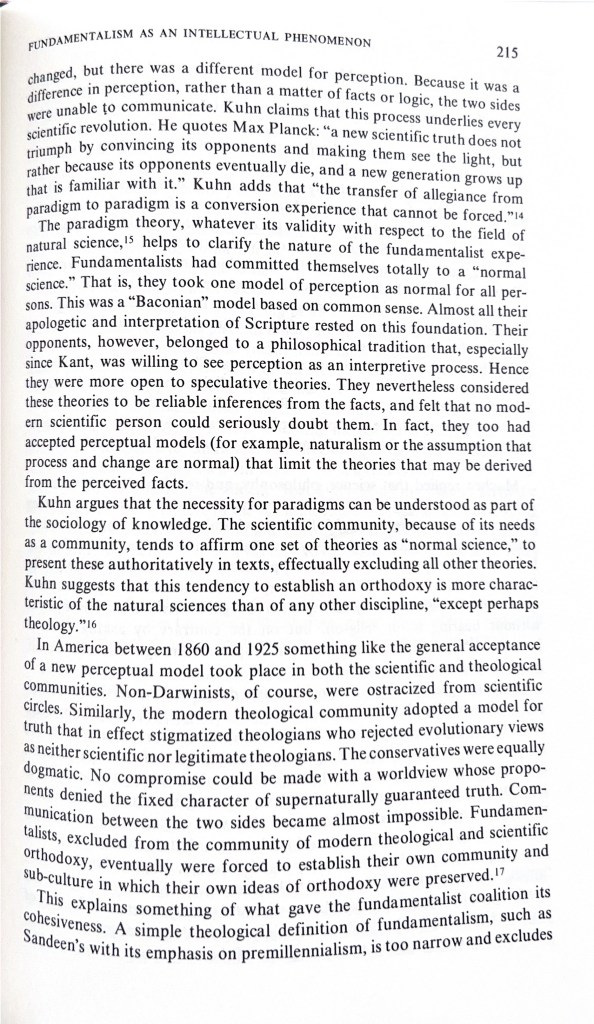
- Fundamentalism and American Culture, George Marsden (Oxford University Press, 1980)
- Mark Noll and George Marsden were colleagues at the University of Notre Dame’s history department, and they produced some of the finest work on American evangelicalism over the last 40 years. This work was one of the first of Marsden’s efforts to understand the relationship between American fundamentalists and the culture they at times despised and wished to overtake. A fascinating thought comes through when he postulates a “paradigm theory” of interpretation between fundamentalists and philosophical liberals. See the image below for more:
- The Printing Press as an Agent of Change, Elizabeth Eisenstein (Cambridge University Press, 1982)
- One of THE definitive voices in media criticism in the past 50 years. Whether you agree with her work or have qualms, it is hard to see any book, article, or dissertation in my corner of academia that does not engage with Eisenstein’s seminal study. Her argument, better distilled in a later presentation, is simple: there was an age of religion, politics, knowledge, and culture before the printing press, and there was a new one after Gutenberg’s invention. The advent of the printing press was the hinge upon which Western civilization swung from medieval to early modern eras. I think that there are some shortcomings in Eisenstein’s work, some from the fact that she was bibliographically limited by the scholarship of her day, and some from the intentional vagueness she poses when getting down to brass tacks on religion and science. That said, her work is a cornerstone in early modern print media studies, and every student must converse with her at one point or another.
Real Life
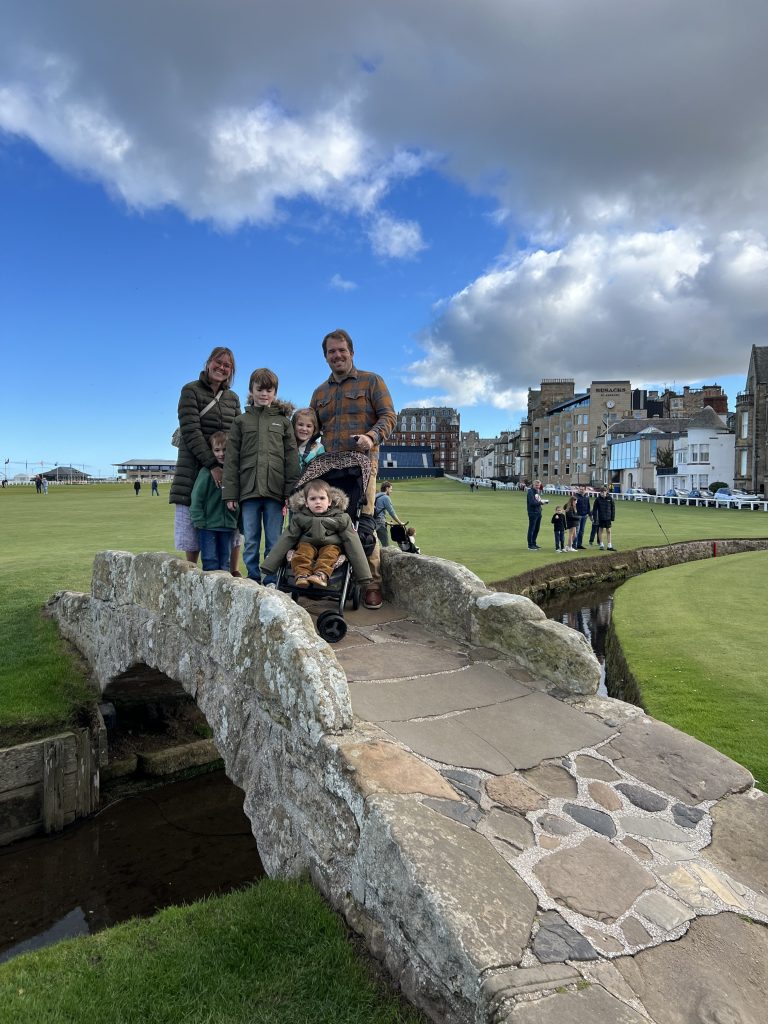
The needs for a vehicle are ever impressing upon us, especially as the longer and rainer winter months are upon us. We spent several hours in the later part of the week calling local car dealers, and are hopefully close to having our own transportation around St Andrews and the surrounding area. More to follow!
But not all was well. Living on the third floor has come with its own learning curve for both parents and children. Most importantly, you might not always have the most generous neighbors on the floor below you, and those grumpy neighbors might complain to your letting agency and confront you at the door one afternoon. Prayers for lighter feet on the floor and more gracious hearts for a family with smaller children.
Conclusion
Pray for our oldest boy, as we are. I don’t want to make too much public right now, but it is safe to say that the LORD is working something in his heart right now. He’s having conversations with his parents, the pastors of his church, and unsurprisingly, just about anyone else he comes across, with some of the biggest questions people ask. We pray that this is a ymomentous occasion for our Craig man!






Leave a Reply